Showing posts with label sblit1. Show all posts

Saturday, 17 November 2012

Closing remarks

To the best of my knowledge, I have finished commenting on the work you have done during the year. Please, let me know if I am mistaken.

The blog will remain open for as long as Blogger decides to keep it. Do come back as often as you want, particularly when revising for the final exam. If you read other people's work, leave a comment, but remember not everyone gets a warning so you could let us know you have done so by other means, for example by tweeting #lit1ros.

Two recurrent language issues:

1- "I haven't thought about it" is incorrect because when you write it you have already considered the issue: It should be "I hadn't thought about it (before you brought it up)"

2- "If I have the chance to ask the author a question, I would..." is incorrect because even if the author is alive (which in most cases they are not), your chances of interviewing them are pretty slim. It should be "If I had the chance..."

I hope you have found the experience of keeping reading journals and using Web 2.0 tools for creative activities enriching, and that you profit from it in the future.

See you soon!

Mariel

Thursday, 8 November 2012

Assignment nº2 : Poetry Anthology


(Edna St. Vincent Millay. 1892-1950)

Oh,Oh you will be sorry for that word!
 Give back my book and take my kiss instead.
 Was it my enemy or my friend I heard,
 "what a big book for such a little head!"
 Come, I will show you now my newest hat,
 And you may watch me purse my mouth and prink!
Oh I shall love you still, and all of that.
I never again shall tell you what I think.
 I shall be sweet and crafty, soft and sly;
You will not catch me reading any more:
 I shall be called a wife to pattern by;
And some day when you knock and push the door,
Some sane day, not too bright and not too stormy,
I shall be gone, and you may whistle for me.                         
( Edna St. Vicent Millay)


 I chose this lyrical poem as it was written by a woman and the main theme is precisely the role of women in society. It talks about a man who considers his wife not intelligent enough to read a book, instead of that, she is supposed to be a model wife, sweet and craft and only caring about buying new things.
  The selection of the pictures is pretty obvious as it shows, on the one hand, the expected model wife, beautiful and only using her head to wear hats and, on the other hand, the woman who has her own interests and is not worried about being what she wants to be, although it may involve leaving her husband.


The Parting  (Michael Drayton. 1563 – 1631)      

SINCE there’s no help, come let us kiss and part –
Nay, I have done, you get no more of me;
And I am glad, yea, glad with all my heart,
That thus so cleanly I myself can free.
Shake hands for ever, cancel all our vows,
And when we meet at any time again,
Be it not seen in either of our brows
That we one jot of former love retain.
Now at the last gasp of Love’s latest breath,
When, his pulse failing, Passion speechless lies,
When Faith is kneeling by his bed of death,
And Innocence is closing up his eyes,
- Now if thou wouldst, when all have given him over,
       From death to life thou might’st him yet recover.


 I chose another lyrical poem because I found the major theme of it really interesting. I talks about a marriage that is coming to an end. At first the husband is glad with the separation as it is a clean break and he enjoys his freedom. But then the mood changes and he reveals that the decision is on her hands...if she wants she can go back and recover his love.

In my opinion, these 2 pictures show both feelings: the first one is portraying divorce as a reason for celebration. The second refers to the second mood explained in this poem, the desire of the narrator to recover the love of his wife.


Annabel Lee (Edgar Allan Poe. 1809-1849)

It was many and many a year ago,
In a kingdom by the sea,
That a maiden there lived whom you may know
By the name of ANNABEL LEE;
And this maiden she lived with no other thought
Than to love and be loved by me.

I was a child and she was a child,
In this kingdom by the sea;
But we loved with a love that was more than love-
I and my Annabel Lee;
With a love that the winged seraphs of heaven
Coveted her and me.

And this was the reason that, long ago,
In this kingdom by the sea,
A wind blew out of a cloud, chilling
My beautiful Annabel Lee;
So that her highborn kinsman came
And bore her away from me,
To shut her up in a sepulchre
In this kingdom by the sea.

The angels, not half so happy in heaven,
Went envying her and me-
Yes!- that was the reason (as all men know,
In this kingdom by the sea)
That the wind came out of the cloud by night,
Chilling and killing my Annabel Lee.

But our love it was stronger by far than the love
Of those who were older than we-
Of many far wiser than we-
And neither the angels in heaven above,
Nor the demons down under the sea,
Can ever dissever my soul from the soul
Of the beautiful Annabel Lee.

For the moon never beams without bringing me dreams
Of the beautiful Annabel Lee;
And the stars never rise but I feel the bright eyes
Of the beautiful Annabel Lee;
And so, all the night-tide, I lie down by the side
Of my darling- my darling- my life and my bride,
In the sepulchre there by the sea,
In her tomb by the sounding sea.


The third poem  is a narrative poem I really enjoyed reading. It is a love poem that tells us the story of two children who deeply love each other...so deeply that the angels of heaven are so envious of that love that decide to kill the little Annabel Lee. Nevertheless, no one can separate them, and that love transcends death and lives forever.
The picture clearly illustrate the love of two infants and this idea is reinforced by the text appearing on it: "Love is a moment that lasts forever".

Tuesday, 6 November 2012

Poetry Anthology

Poetry Anthology:Lyrical and Narrative poems.

  The Hind

Whoso list to hunt, I know where is an hind,
 But as for me, helas! I may no more.
 The vain travail hath wearied me so sore,
 I am of them that furthest come behind.
 Yet may I, by no means, my wearied mind
 Draw from the deer;but as the fleeth afore
 Fainting I follow I leave off therefore ,
 Since in a net I seek to hold the wind.
Who list her hunt, I put him out of doubt,
As well as I, may spend his time in vain;
And graven with diamonds in letter plain
There is written, her fair neck round about,
 Noli me tangere, for Caesar's I am,
 And wild for to hold, though I seem tame.
 (Sir Thomas Wyatt)


 Oh,Oh you will be sorry for that word!

 Give back my book and take my kiss instead.
 Was is my enemy or my friend I heard,
 "what a big book for such a little head!"
 Come, I will show you now my newest hat,
 And you may watch me purse my mouth and prink!
Oh I shall love you still, and all of that.
I never again shall tell you what I think.
 I shall be sweet and crafty, soft and sly;
You will not catch me reading any more:
 I shall be called a wife to pattern by;
And some day when you knock and push the door,
Some sane day, not too bright and not too stormy,
I shall be gone, and you may whistle for me.
( Edna St. Vicent Millay)


The Wife of Bath's Tale (extract)
Now it so happened, I began to say,
Long, long ago in good King Arthur's day,
There was a knight who was a lusty liver.
One day as he came riding from the river
He saw a maiden walking all forlorn
Ahead of him, alone as she was born.
And of that maiden, spite of all she said,
By very force he took her maidenhead.
This act of violence made such a stir,
So much petitioning to the king for her,
That he condemned the knight to lose his head
By course of law. He was as good as dead
(It seems that then the satutes took that view)
But that the queen, and other ladies too,
Implored the king to exercise his grace
So ceasellessly, he gave the queen the case
And granted her his life, and she could choose
Whether to show mercy or refuse.


I've chosen these poems because I think that they show different women being powerful so as to be and do whatever they want with men and with their lives.
The first woman is very coquette and encourages men to follow her because she enjoys her power over men and enjoys the way men try to get her love. She can do with them whatever she wants. That's why I've chosen that picture as it clearly shows a coquette women being followed by men.
The second woman enjoys reading and she will keep on doing it eventhough her husband doesn't want her to read. She is strong enough to confront with her husband and make him clear that she will pretend to be what he asks her to be but she will not stop reading. I've chosen these pictures because they show a woman with her husband (may be in a party) showing that they are a very happy couple, and then the other picture a woman alone reading and enjoying this activity.
The third woman is a queen and it is shown that  she has power on the king as he let her choose what to do with the knight. I like this  picture as it can represent the ladies and the queen dealing with the Knigth's case.


Saturday, 3 November 2012

A Streetcar Named Desire: some complementary information

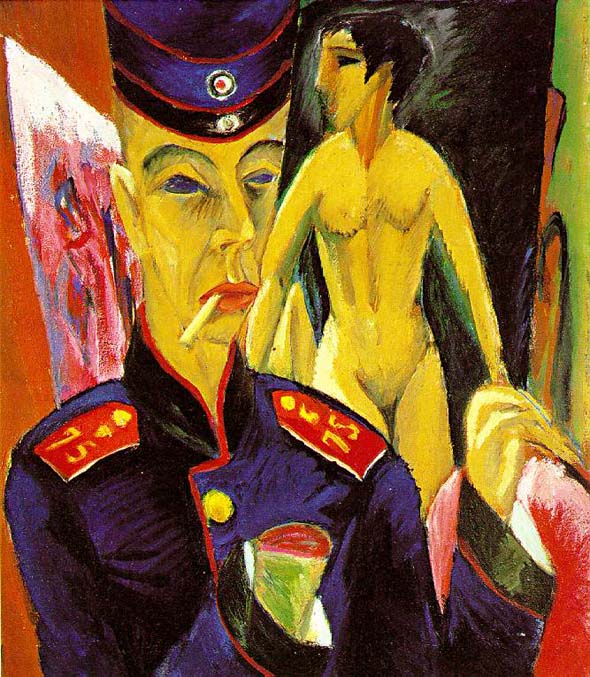
Tennessee Williams relies on expressionistic techniques in many of his plays, including Streetcar.


Expressionism is originally associated with fine arts:


Read a characterisation of the movement, or this other one.

Norwegian artist Edvard Munch was a key forerunner. This is his most famous work, The Scream (1893)


A German representative artist is Ernst Ludwig Kirchner. This is Self-Portrait as a Soldier (1915)


The epigraph of the play is taken from "The Broken Tower" by Hart Crane. Read the full poem

The stage directions to Scene 3 ("The Poker Night") mention a Van Gogh painting´, which has been identified as The Night Café (1888):


Scene 7 sees Blanche singing "It's Only a Paper Moon". Listen to this popular song or read the lyrics.


Finally, you may want to take this Google Earth tour. You will need to download the attachment mentioned there:
http://bbs.keyhole.com/ubb/ubbthreads.php?ubb=showflat&Number=5...

Friday, 2 November 2012

Assignment No. 2 - Anthology

ANTHOLOGY: http://prezi.com/fmh82bu1kuxv/literature-in-english-i-assignment-no-2/

Maya Angelou is someone who I got to admire, in all the poems I have read she shows all her strength. 

This poem tells the story of many africanamerican women who fought against the strong oppression of a hateful community who would hold them back.
This is one of the many poems which can make you feel strong, filled hope and passion, and pushes you to carry on in spite of any obstacle. Every word used in the poems tells us everything about her, and her attitude towards what she writes.
The picture shows her free spirit and her vigour. Love her! 

Edgar Allan Poe offers mystery and madness in "The Raven". This narrative poem, provides lots of instancies of alliteration, which provides a particular rithm and use of "music". I did not want to provide the most important part because I woud like you to read it all!!! I will only tell you that the narrator asks the raven questions knowing which will be the answer (the only works that thw bird says). He is somehow turtured by the raven as he only has negative answers.

The image I chose is represents when the raven appears and the owner of the voice is revealed.

Tolkien is someone who I believe has one of the greatests minds. He created an entire world of magic and fantasy, bringing mortals and inmortals together!!  The epic novel "The Lord of the rings" is primarily written in narrative, but it has many instances of lyric poem. I chose an unforgetable verse, The sounds that every word carry have the same power that "the rings" have; as we get to the-one-ring, we can notice that is not like the others.

I chose that image because it represents the moment in which the verse is revealed, in the unique language chosen by Tolkien, "elvish". 

Wednesday, 31 October 2012

Post 3: After reading the whole play

To my view, the most important ideas/themes in this play are...
Love, I think the whole play is about love and the relationships between people who have strong feelings. " I like you to be exactly the way you are, because in all my experience-- I have never known anyone like you" (Mitch, scene 6)
Death and tragedy, "We danced the Varsouviana! Suddenly in the middle of the dance the boy I had married broke away from me and run out of the casino. A few moments later -- a shot!"( Blanche, scene 6)
Desire, Mitch [drawing her slowly into his arms]: You need somebody. And I need somebody too. Could it be--you and me, Blanche?  ( Mitch, scene 6)
I think that all through the novel the characters feel desire for something, in some cases... a person to love, in others... money, fun, etc.

In my opinion, the tittle has to do with the streetcar´s name that takes Blanche to her sister´s house and also with the character´s feelings. All through the play, desire is involved. This happens, for example, when Blanche has sex with the sixteen year-old guy, when she meets Mitch or when she wants her daughter not to be with Stanley, when she is rapped by Stanley, etc. Desire is also involved in the rest of the character´s life, for example the need of Mitch to be married, to have his mother healthy and to be with Blanche and Stanley´s madness for the poker nights.

The play makes me think about decisions we make in life, how important is to think carefully what we do and what we have to do... what is better for us and what makes us happy enough to continue. Sometimes we tend to underestimate people without even knowing who they are. Maybe they have made mistakes in life but all the same in the deepness of their hearts they´re good people. All of us want to be desired by someone and have someone next to us to share our days, but if we´re not sincere and clear enough we may deeply hurt them and us as well.

If I got the chance to ask the writer a question I would ask him why did Stella did nothing and let her sister go in that situation?

Friday, 26 October 2012

Post 2: After reading scene five

So far my predictions have been confirmed. Personally, I think that those funny and haunting dialogues are what make me feel interested in the play. The way and manner characters talk to each other is very funny and ironic as well, but the one who catches my attention the most is Blanche. She is deliciously ironic and the conversations that she has with Stanley are particularly interesting.

As regards light, music and stage directions, I think that they are absolutely indispensable for the play. They add to the atmosphere and give us, readers,  the possibility to imagine ourselves present in every single scene.

My quotation is:
" All right. Cards on the table. That suits me". (Blanche,scene 2,  page 45)

I think that this quotation show us that Blanche is a good person beyond all. Blanche is sincere with her sister and everybody there as regards the loose of Belle Reve. She is honest and she says the truth. Also, I think that this quotation is important to keep in mind all throughout the play because then nobody trust her about Stanley´s rape.

Post 3- Street Car Named Desire- Clarisa Franceschelli


For me the main themes that appear in the play are:

°         Love: Stella: He promised this morning that he was going to quit   having   these   poker   parties,   but   you   know   how   long   such   a promise   is   going   to   keep.   Oh,   well,   it's   his   pleasure,   like mine   is movies and bridge.  People have got to tolerate each other’s habits, I guess.
°         Money: Blanche: Oh,   let   me   think,   if   only   my   mind   would   function!   We've   got   to   get hold of some money, that's the way out!
°         Insanity: Blanche [holding tight to his arm]: Whoever   you   are--I   have   always   depended   on   the   kindness   of .strangers
°         Death and tragedy: Blanche: We   danced   the Varsouviana! Suddenly   in   the   middle   of   the   dance the   boy  I   had   married   broke   away   from   me   and   ran   out   of   the casino.A few moments later--a shot!

As regards the title, there is part in the play where Stella is talking to Blanche after
Stella and Stan had the terrible fight:
BLANCHE:
What you are talking about is brutal desire--just--Desire!--the  name of that  rattle-trap   streetcar that bangs through the Quarter ,up one old narrow street and down another....
STELLA:
Haven't you ever ridden on that streetcar?

I believe that the title refers to the fact that people are driven by desires in life, and that is what makes us live. There are different kinds of desire that lead us into different directions and places in life.

When reading the play I thought a lot about family, and how important is to have family or friends around you when you are going through some difficulty in life. I believe Blanche has to overcome many situations alone and that is what disturbed her so much. The tragedy she had to face plus the death of her parents and the responsibility to try to save the family house was too much for her to handle. I feel like Stella wanted to protect her all the time while Stan did not trusted Blanche until he realized she had a problem and just then he became sympathetic towards her.

Something I did not mentioned previously about the setting is that the song Blanche danced with his husband the day he died, the Varsoviana, is heard in many parts in the story. I think that music accompanies the feelings of the characters.

If I could ask one question to the author I would ask her why Mitch and Blanche did not have the chance to start a relationship or something together. I think that they both care about each other and it may have worked.

Thursday, 18 October 2012

POST 1 : Before reading

The characters mentioned are an English Teacher called Blanche who is the protagonist together with Stella her sister and Stanley, Stella´s husband.
As regards the setting, I can see that they live in a messy and small apartment. Apparently, they have not enough money to prosper or live in better conditions. It seems that death and sex combined with humor are the main features that developed into this novel. I can deduce from what the author says in the video that we will be trapped by the perfect amalgam of comedy and tragedy of this novel.

Tuesday, 16 October 2012

Post 2- A Street Car Named Desire- Clarisa Franceschelli


So far I’ve confirmed that humour and mystery are included in the play since some of the conversations are quite humorous or ironic at times. There is also violence in the play, some of the characters doesn’t get on very well and some others loose their temper easily like when Stanley get angry with Stella.
For me Stella is the most transparent character, she is the one who shows her real feelings. While her husband and her sister are a bit mysterious to me, obviously Blanche is more mysterious then Stanley.
I believe that stage directions and setting are very useful for us, since we are not watching the play and we could miss some details if the directions an the setting weren’t present. It would be only dialogue which would make the play very unpleasant to read.
As I sad before Stella is the one who is more constant with her behaviour while Stanley is a bit temperamental, may be when he is under the influence of alcohol. As regards Blanche, I really don’t know. She puzzles me.

“I wasn’t so good the last two years or so, after Belle Reve had started to slip through my fingers”- Blanche

I like this quotation because after criticizing her husband’s sister and telling her off, Blanche is finally admitting she is not so good after all. May be the rumours about her (I don’t know which rumours) are true…Blanche has her hands in something.

Friday, 12 October 2012

Post 1 A Streetcar Named Desire- Clarisa Franceschelli


The characters mentioned are Blanche who is the protagonist and an English teacher, her sister, Stella, and her husband. The setting seems to be pretty derelict, they live in a small place and apparently they don’t have enough money to live in better conditions.

Taking into account some of the comments that appeared in one of the videos the play themes are sex and death, but maybe not in a tragic way but in a humorous way because the director mentions humour as well. So I believe that the play may be mysterious since death is involved and also, according to the review, Blanche doesn’t want to face the truth. May be there is something to be revealed.

Thursday, 9 August 2012

Assignment I: part II. Angela Bordi & Cecilia Pedrido

Here is the link of part II of our assignment. We've done Nick Carraway's fakebook. We've chosen one of the first parties Nick and Jordan witnessed in Gatsby's house. One reason for choosing that scene is because we wanted to make Amata be present and made her talk about her misfortune in love with a little of irony. What's more, we wanted to show how we imagined the characters were feeling at that moment but in a more relaxed way than it was in the book. We hope you enjoy it a lot and that you can find the sense of irony and comedy that we wanted to share. http://www.classtools.net/fb/6/W9B979


View Fullscreen | Create your own

Saturday, 30 June 2012

Post 3 Clarisa Franceschelli


This is the 2nd time I read “The Great Gatsby”. At first I thought that it would be a drag for me to read it again, but I was wrong. Since I didn’t remember the ending (and some other details) I was looking forward to reaching the end.

For me the most striking moment was Gatsby’s death (I didn’t remember that). It was something unexpected and unfair… And it was also surprising when Gatsby’s father appeared. The old man, who wasn’t mentioned before, seemed to be very proud of his son. I believe Gatsby deserved this farewell.

When reading the novel I thought a lot about unhappiness and insincerity because most of the characters weren’t happy with their lives. They were just resigned to a life full or comfort and luxuries but no happy moments. It was only Gatsby the one that fought for what he really wanted. To my mind, he was the bravest character because he took the plunge in order to be with his love again and to realize his dream.

If I had the chance, I would ask Fitzgerald if he let Gatsby die in order to add even more drama in the character's life. I believe that the fact that he is murdered make the reader think “poor guy”…I mean, he had to let her love go in order to fight in a war, then he did everything to get her back. And when he was finally fulfilling his dream, after all his efforts, he is accused of killing a woman and then he is murdered. A bit too much for one human being, don't you think?

Anyway, although the ending is unfair to me, I liked reading the story because it portrays the twenties in really colourful way and it is full of very detailed descriptions that help us picture in our mind every place and every character.

Friday, 29 June 2012

Post 2 Clarisa Franceschelli

I believe that the story changes a lot since Gatsby meets Daisy. This encounter provokes conisderable changes in the characters and in the plot as well .
Nick, who before was Tom’s accomplice, now helps Gatsby and becomes his only friend. Jay Gatsby is finally described, he is a very calm man, who only wants to go back to the past and get Daisy’s love back.
Daisy starts showing her real feelings for her husband and she starts changing her attitude towards him. She seems to be puzzled about Gatsby’s appearance but at the same time she is curious and excited about it.
Tom and Gatsby don’t get along very well. And Tom starts suspecting about Daisy’s and her relationship with her new friend. I believe Tom is afraid of loosing her.

“An hour later the front door opened nervously, and Gatsby, in a white flannel suit, silver shirt, and gold-colored tie, hurried in. He was pale, and there were dark signs of sleeplessness beneath his eyes.”

“Gatsby, pale as death, with his hands plunged like weights in his coat pockets, was standing in a puddle of water glaring tragically into my eyes.”
            
 I’ve chosen these quotations for several reasons. First of all I can picture Gatsby in mi mind and for me it is really funny to see a man in his thirties being so nervous about meeting a woman. At this point in the story he looks like a frightened child to me. Secondly, this part clearly shows how important is Daisy in his life. He has a mixture of feelings; he is nervous, and happy and terrified all at the same time. He wants to impress Daisy, and he has been waiting for this moment for a long time. For him, this is the beginning of the rest of his life, he is starting to live his dream, at least this is what he thinks…

Friday, 15 June 2012

Post 1 Clarisa Franceschelli

The characters that appeared so far are:
 • Nick Carraway is the man telling the story. He is graduated from New Heaven and he was at war. Now he wants to start a new life, far from his ex-girlfriend, in West Egg. He is into the bond business. Not very much it is said about his personality, but for me he keeps a low profile. 
• Daisy is Nick’s second cousin, they haven’t seen for ages now, but she seems to care a lot about him. Apparently, she gets very emotional at times and she doesn’t seem to be very happy with her life. In chapter 1, her face is described as sad and lonely. But she is no fool since she knows or, at least, she suspects that her husband, Tom Buchanan, is having an affaire. 
• Tom and Nick know each other from university. In those years Tom was a powerful football player. Now Tom is married to Daisy and the pretend to be a perfect family which they are not. He is an arrogant person and, from some attitudes that can be seen he is violent too. • Jordan Baker is a lively and curious young woman. She is a friend of a Buchanan’s and she is staying in their house. In the book it is mentioned that she is playing a tournament but the sport is not mentioned so it remains unknown. 
• Mrs. Wilson is Tom’s mistress. They have a lot in common since she is arrogant too and she is cheating on her husband, Mr. Wilson, as well. However, she isn’t happy about her marriage and about the fact that Tom is still married to Daisy. 
• Finally, Gatsby. Until now, he is only mentioned. He is described as a wealthy man whose money comes from a Kaiser and he throws great parties. 
I believe that some of the characters have things in common. Some are wealthy, some aren’t. But I feel they all are restraining their emotions. 
The quotation I’ve chosen is at the end of chapter 1: 
 “When I looked once more for Gatsby he had vanished, and I was alone again in the unquiet darkness.” 
It is a very short one but I liked it because the idea of Gatsby vanishing makes him even more mysterious. I’ve read two chapters already and he doesn’t appear or interacts with other character in any of the chapters. In a book that carries his name, isn’t it puzzling? We’ll have to keep reading to get to know him…