Showing posts with label drama. Show all posts

Saturday, 3 November 2012

A Streetcar Named Desire: some complementary information

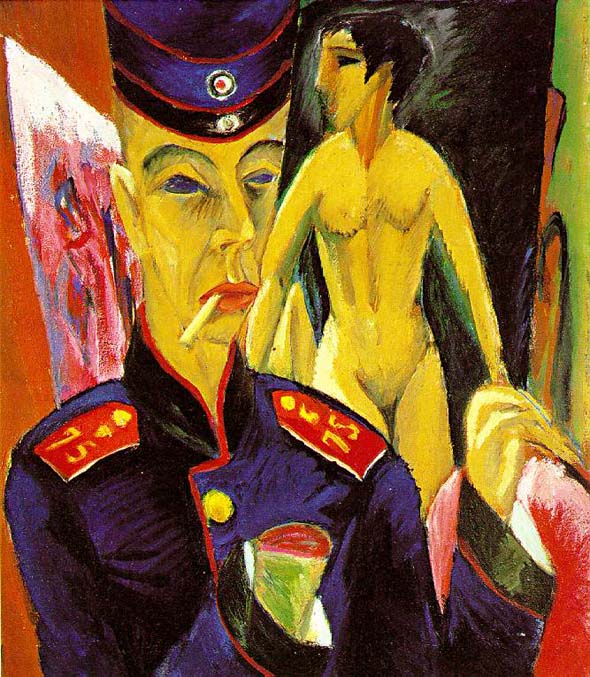
Tennessee Williams relies on expressionistic techniques in many of his plays, including Streetcar.


Expressionism is originally associated with fine arts:


Read a characterisation of the movement, or this other one.

Norwegian artist Edvard Munch was a key forerunner. This is his most famous work, The Scream (1893)


A German representative artist is Ernst Ludwig Kirchner. This is Self-Portrait as a Soldier (1915)


The epigraph of the play is taken from "The Broken Tower" by Hart Crane. Read the full poem

The stage directions to Scene 3 ("The Poker Night") mention a Van Gogh painting´, which has been identified as The Night Café (1888):


Scene 7 sees Blanche singing "It's Only a Paper Moon". Listen to this popular song or read the lyrics.


Finally, you may want to take this Google Earth tour. You will need to download the attachment mentioned there:
http://bbs.keyhole.com/ubb/ubbthreads.php?ubb=showflat&Number=5...

Friday, 2 November 2012

Post 3: After reading the whole play


I consider honour is the central theme in this play, not honour form a broad perspective but particularly in connection with virginity. Related to this, Leonato says:
“O Fate, take not away thy heavy hand!
Death is the fairest cover for her shame
That may be wished for.”
Clearly he is wishing for his daughter’s death immediately after he is told she is not a virgin, which brings shame not only on Hero but also on the whole family, ruining their reputation.
As regards the title, I want to consider 2 different interpretations of it. The first and more literal one is the one explained by Mariel (Loreto) which refers to a phrase used to describe a situation in which there has been a lot of excitement about something that is not really important. In this case, there is a frustrated marriage and a lot of suffering around a fictitious situation, i.e. Hero’s unfaithfulness to Claudio.
The second interpretation I want to mention is that, by the time this play was written, the word “nothing” was pronounced in the same way as “noting”. This meaning of the title refers to the fact that the characters spend the whole play noting what the others do and that leads to the development of the main events. Consequently, at that time there probably was a more evident wordplay.
What surprised me most about the play and made me think a lot about it is the way in which love is presented. As we discussed in class, Hero and Claudio almost don’t know each other but they agree on getting married. On the other hand, although Beatrice and Benedick apparently have had a sort of relationship in the past, they are (at first) too proud to admit their love for each other. In both cases...are we really talking about true love???
If I had the chance to ask William Shakespeare one question I would ask him what he really thinks about the central themes of their plays: marriage, love, the role of women, among others. I am interested in knowing if he considers these issues as he portrays them in his plays or if it is a sort of criticism intending people reflect on them.

Thursday, 1 November 2012

Post 3: After reading the whole play


 The themes or important ideas are the necessity to marry for social benefits, the importance of virginity and the deception that these can bring to a relation: loss of honor and shame.

The lines of Leonato, Hero’s father in the Church: 
“Do not live, Hero; do not ope thine eyes:
For, did I think thou wouldst not quickly die,
Thought I thy spirits were stronger than thy shames,
Myself would, on the rearward of reproaches,
Strike at thy life. Grieved I, I had but one?
I might have said “No part of it is mine;
This shame derives itself from unknown loins”?”

I believe that the title is as unusual and amusing as the play must have been in the 16th Century. At the same time it already suggests what is going to happen; we should not care too much about things that others consider we should care a lot about.

I would ask Shakespeare, why he decided to deal with sensible themes from a humorous point of view?

Wednesday, 31 October 2012

Post 3: After reading the whole play

To my view, the most important ideas/themes in this play are...
Love, I think the whole play is about love and the relationships between people who have strong feelings. " I like you to be exactly the way you are, because in all my experience-- I have never known anyone like you" (Mitch, scene 6)
Death and tragedy, "We danced the Varsouviana! Suddenly in the middle of the dance the boy I had married broke away from me and run out of the casino. A few moments later -- a shot!"( Blanche, scene 6)
Desire, Mitch [drawing her slowly into his arms]: You need somebody. And I need somebody too. Could it be--you and me, Blanche?  ( Mitch, scene 6)
I think that all through the novel the characters feel desire for something, in some cases... a person to love, in others... money, fun, etc.

In my opinion, the tittle has to do with the streetcar´s name that takes Blanche to her sister´s house and also with the character´s feelings. All through the play, desire is involved. This happens, for example, when Blanche has sex with the sixteen year-old guy, when she meets Mitch or when she wants her daughter not to be with Stanley, when she is rapped by Stanley, etc. Desire is also involved in the rest of the character´s life, for example the need of Mitch to be married, to have his mother healthy and to be with Blanche and Stanley´s madness for the poker nights.

The play makes me think about decisions we make in life, how important is to think carefully what we do and what we have to do... what is better for us and what makes us happy enough to continue. Sometimes we tend to underestimate people without even knowing who they are. Maybe they have made mistakes in life but all the same in the deepness of their hearts they´re good people. All of us want to be desired by someone and have someone next to us to share our days, but if we´re not sincere and clear enough we may deeply hurt them and us as well.

If I got the chance to ask the writer a question I would ask him why did Stella did nothing and let her sister go in that situation?

Friday, 26 October 2012

Post 2: After reading scene five

So far my predictions have been confirmed. Personally, I think that those funny and haunting dialogues are what make me feel interested in the play. The way and manner characters talk to each other is very funny and ironic as well, but the one who catches my attention the most is Blanche. She is deliciously ironic and the conversations that she has with Stanley are particularly interesting.

As regards light, music and stage directions, I think that they are absolutely indispensable for the play. They add to the atmosphere and give us, readers,  the possibility to imagine ourselves present in every single scene.

My quotation is:
" All right. Cards on the table. That suits me". (Blanche,scene 2,  page 45)

I think that this quotation show us that Blanche is a good person beyond all. Blanche is sincere with her sister and everybody there as regards the loose of Belle Reve. She is honest and she says the truth. Also, I think that this quotation is important to keep in mind all throughout the play because then nobody trust her about Stanley´s rape.

Post 3- Street Car Named Desire- Clarisa Franceschelli


For me the main themes that appear in the play are:

°         Love: Stella: He promised this morning that he was going to quit   having   these   poker   parties,   but   you   know   how   long   such   a promise   is   going   to   keep.   Oh,   well,   it's   his   pleasure,   like mine   is movies and bridge.  People have got to tolerate each other’s habits, I guess.
°         Money: Blanche: Oh,   let   me   think,   if   only   my   mind   would   function!   We've   got   to   get hold of some money, that's the way out!
°         Insanity: Blanche [holding tight to his arm]: Whoever   you   are--I   have   always   depended   on   the   kindness   of .strangers
°         Death and tragedy: Blanche: We   danced   the Varsouviana! Suddenly   in   the   middle   of   the   dance the   boy  I   had   married   broke   away   from   me   and   ran   out   of   the casino.A few moments later--a shot!

As regards the title, there is part in the play where Stella is talking to Blanche after
Stella and Stan had the terrible fight:
BLANCHE:
What you are talking about is brutal desire--just--Desire!--the  name of that  rattle-trap   streetcar that bangs through the Quarter ,up one old narrow street and down another....
STELLA:
Haven't you ever ridden on that streetcar?

I believe that the title refers to the fact that people are driven by desires in life, and that is what makes us live. There are different kinds of desire that lead us into different directions and places in life.

When reading the play I thought a lot about family, and how important is to have family or friends around you when you are going through some difficulty in life. I believe Blanche has to overcome many situations alone and that is what disturbed her so much. The tragedy she had to face plus the death of her parents and the responsibility to try to save the family house was too much for her to handle. I feel like Stella wanted to protect her all the time while Stan did not trusted Blanche until he realized she had a problem and just then he became sympathetic towards her.

Something I did not mentioned previously about the setting is that the song Blanche danced with his husband the day he died, the Varsoviana, is heard in many parts in the story. I think that music accompanies the feelings of the characters.

If I could ask one question to the author I would ask her why Mitch and Blanche did not have the chance to start a relationship or something together. I think that they both care about each other and it may have worked.

Friday, 19 October 2012

Post 3: After reading the whole play.

Well, I have finally finished reading the play. One of the most important themes in it is marriage, which is central in the plot. Hero and Claudio are quick to fall in love and marry, whereas Beatrice and Benedick scoff at the idea. But they are prepared to reconsider their position, as Benedick says:
I have railed so long against marriage: but doth not the appetite alter? […] No, the world must be peopled. When I said I would die a bachelor, I did not think I should live till I were married.
Another important theme is subterfuge, the use of lies and tricks as a means to an end. Don Pedro wooing Hero in the name of Claudio and the convoluted plan to pair Beatrice off with Benedick are examples of deceit used as a force for good. On the other hand, the slander against Hero which severely damaged her reputation is the villains's main crime in the play, as Dogberry repeatedly states:
DOGBERRY: Marry, sir, they have committed false report, moreover they have spoken untruths, secondarily, they are slanders, sixth and lastly, they have belied a lady, thirdly they have verified unjust things, and to conclude, they are lying knaves.
Finally, the importance of honour, which for a woman was based upon her chastity, is also significant in the play. It was the accusations of immoral behaviour that almost killed Hero, and brought shame on her family. Claudio publicly humiliates her by saying:
You seem to me as Dian in her orb,
As chaste as is the bud ere it be blown:
But you are more intemperate in your blood,
Than Venus, or those pampered animals,
That rage in savage sensuality.
Hero fainting at the church, Engraving, 1798

Regarding the title of the play, I feel is quite apt. The characters make a big fuss about very little. If it weren´t for the impulsiveness and gullibility of certain characters, the villains’ plans would not have been successful.


I found it surprising how cruel Claudio could be, and how he went to great lengths to hurt Hero after learning about her alleged libertine behaviour. It made me think how easily love can end up becoming hate, and how slander and rumour can injure someone's reputation. We need to understand how serious an accusation of unchastity was in those times.


If I could ask Shakespeare a question, it would be a simple one: Who are you? There has been heated debated about the real identity of the playwright, and it would be a relief to have the matter finally settled.

Thursday, 18 October 2012

Post 1 - Much ado about nothing


       What is the most relevant information provided, in your view? What is the most surprising?
In my view, the most relevant information is that the theater was located the seedy part of town frequented by morally rejected people. Probably, they must have been incapable of understanding anything Shakespeare’s plays, but because they might have been attracted by the glamour that a play could offer, this could have been  positive if they attended regularly to the performances at the Globe Theater. The things that surprised me were that the actors could appear from different places: the ceiling, a trap door; the theater could house a large number of spectators who did not care if they had “to stand through a performance under a hot sun or threatening clouds”; what’s more, there was not curtain that opened or closed the beginning or end of the plays, this last feature of this theater together with the images showed in the video reminded me of the Coliseum in Rome.

      How do you think the acting conditions will affect the development of the plot?
Absolutely! I suppose that the size of the theater and the number of people (booing and hissing the actors) required a strong, clear, loud voice. Actors playing supernatural characters may have had certain strength to be able to “descend to earth from heaven”.

How do these two versions compare? Why? Who do you expect the protagonists will be? What do they seem to be like?
Taking into account the setting, in the first version it looks like a recreation of the furniture and painted background of a theatre stage. However, the trailer of the second film shows more real places. Probably it is due to technology advances or remaining loyal to what it may have been a performance played in the actual theater.
 I believe the protagonists will be Claudio and Beatrice. Claudio seems to be a young man and very naïve. Beatrice is very different, very outspoken and sarcastic. 

POST 1 : Before reading

The characters mentioned are an English Teacher called Blanche who is the protagonist together with Stella her sister and Stanley, Stella´s husband.
As regards the setting, I can see that they live in a messy and small apartment. Apparently, they have not enough money to prosper or live in better conditions. It seems that death and sex combined with humor are the main features that developed into this novel. I can deduce from what the author says in the video that we will be trapped by the perfect amalgam of comedy and tragedy of this novel.

Post II: After reading Act III

Mi first impression about Benedick and Beatrice was that they would be a sort of enemies throughout the whole play. Obviously, this prediction was immediately contradicted as they, with a little help of their friends, fall in love with each other.
I really like Beatrice as she has a strong character, she shows herself as being a clever woman, very talkative, who always says what she really thinks without caring about other people's opinions and usually making use of a mocking tone. She is a confirmed bachelorette who refuses to marry anybody and what's more striking is that she seems to be happy about it!

Later in the play, we learn that her decision about marriage is not so irrevocable as she falls in love with Benedick and I imagine she will reconsider it. As Walter mentioned before, another noticeable change in the play occurs at the level of the tone, as it starts as a happy comedy but, by the end of the 3erd Act, it becomes dark and almost tragic, as it involves a lot of suffering on the part of Claudio and Hero who are about to get married but are tricked by Don John and his men who convince Claudio that Hero is unfaithful to him.

Humour is achieved mainly by 3 characters. First, Beatrice is in charge of it as she constantly mocks Benedick, but then, 2 funny characters appear on scene: Dogberry and Verges who are 2 watchmen who bring about a series of innocent misunderstandings that prevent Hero and Claudio from having a happy wedding.

Quotation:
Beatrice: " What should I do with him? Dress him in my apparel and make him my waiting gentlewoman? He that hath a beard is more than a youth, and he that hath no beard is less than a man; and he that is more than a youth is not for me, and he that is less than a man, I am not for him. Therefore I will even take sixpence in earnest of the bearherd, and lead his apes into hell." (Act 2. Scene 1)

I chose this quotation because I think this is a very witty remark that clearly portrays Beatrice as she really is. While reading it I thought she may adopt this posture towards love to protect herself from her own vulnerability and to avoid being damaged by men. I imagine she had bad experiences with men before or maybe she has not found the correct one...yet.

Tuesday, 16 October 2012

Post 2- A Street Car Named Desire- Clarisa Franceschelli


So far I’ve confirmed that humour and mystery are included in the play since some of the conversations are quite humorous or ironic at times. There is also violence in the play, some of the characters doesn’t get on very well and some others loose their temper easily like when Stanley get angry with Stella.
For me Stella is the most transparent character, she is the one who shows her real feelings. While her husband and her sister are a bit mysterious to me, obviously Blanche is more mysterious then Stanley.
I believe that stage directions and setting are very useful for us, since we are not watching the play and we could miss some details if the directions an the setting weren’t present. It would be only dialogue which would make the play very unpleasant to read.
As I sad before Stella is the one who is more constant with her behaviour while Stanley is a bit temperamental, may be when he is under the influence of alcohol. As regards Blanche, I really don’t know. She puzzles me.

“I wasn’t so good the last two years or so, after Belle Reve had started to slip through my fingers”- Blanche

I like this quotation because after criticizing her husband’s sister and telling her off, Blanche is finally admitting she is not so good after all. May be the rumours about her (I don’t know which rumours) are true…Blanche has her hands in something.

Monday, 15 October 2012

Post 2: After reading Act III

So far, my predictions about the characters have been spot on. Benedick and Beatrice are two confirmed bachelors, who are in a kind of merry war betwixt them. They scorn love, and swear they will never marry. Evidently they are in love with each other; they just don’t know it yet. At least that is what their friends think, for Don Pedro, Hero, Claudio and Leonato decide to resort to a ploy and try to convince Benedick that Beatrice is in love with him, and vice versa.

The other characters I like best so far are Dogberry and Verges. They are two watchmen who provide comic relief. They bring humour to the play by their misuse of words, often by confusing two words of similar sound.

The play starts as a happy comedy, one in which misunderstandings and eavesdropping set the plot in motion. But at the end of Act 3, the villain is about to be successful, having led Claudio and Don Pedro to believe that Hero is not chaste. Therefore, the atmosphere of the play grows dark, as Claudio and Don Pedro intend to shame Hero publicly, exposing her as a slut.

Humour is achieved through the use of witty ditties, puns, and extended metaphors which amount to analogies. There are also malapropisms (incorrect uses of words) via Dogberry. As regards the use of verse and prose, we can observe that prose is predominant in the play, with verse restricted to serious matters, and only spoken by aristocratic characters.
BENEDICK Ha, against my will I am sent to bid you come in to dinner:
there's a double meaning in that: I took no more pains for those
thanks than you took pains to thank me: that's as much as to say, any
pains that I take for you is as easy as thanks: if I do not take pity of
her I am a villain, if I do not love her I am a Jew, I will go get her
picture.
I choose this quotation because it is simply hilarious. After having been tricked into believing that Beatrice is madly in love with him, Benedick sees second meanings where there are none. 

Friday, 12 October 2012

Post 1 A Streetcar Named Desire- Clarisa Franceschelli


The characters mentioned are Blanche who is the protagonist and an English teacher, her sister, Stella, and her husband. The setting seems to be pretty derelict, they live in a small place and apparently they don’t have enough money to live in better conditions.

Taking into account some of the comments that appeared in one of the videos the play themes are sex and death, but maybe not in a tragic way but in a humorous way because the director mentions humour as well. So I believe that the play may be mysterious since death is involved and also, according to the review, Blanche doesn’t want to face the truth. May be there is something to be revealed.

Tuesday, 18 September 2012

Much Ado About Nothing: Reading Journal

Shakespeare's Globe Theatre

The Globe Theatre was reconstructed in London in 1997


The first video describes the Globe Theatre. It was built west of London Bridge on the South bank of the river Thames in an area known as Bankside. The original Globe Theatre was just a wood frame building. The interior resembled a modern opera house with three galleries protected from rain and sunlight by a roof. Between two thousand and three thousand playgoers would pay two or more pennies to sit in these galleries. The stage was raised four to six feet from ground level and had a roof supported by pillars. In front of the stage there was a roofless yard for up to one thousand groundlings that paid a penny to stand through the performance under the hot sun or rain. At the rear of the stage was an inner stage separated from the front by a draw-curtain. The dressing rooms of the actors were collectively known as the “Tiring House”. Props and backdrops were few, as the exact locality for a scene wasn´t usually important and when it was necessary the playwright showed it in the dialogue. The actors weren´t separated from the audience, so a common experience was possible. The action was continuous, as there wasn´t a main curtain. The lack of artificial light meant that the plays had to be performed during the afternoons.
It struck me as odd that the Globe theatre was located in the seedy section of town, an area frequented by prostitutes, pickpockets and other unsavoury people. So definitely the theatre and Shakespeare himself weren`t as glamorous as one may think.

Much Ado About Nothing

This two versions of Much Ado About Nothing are quite different. The first one resembles a theatre play, and it seems to be more faithful to the original. The second one appears to be a big-budget Hollywood movie, starring well-known actors and actresses such as Emma Thompson, Kate Beckinsale, Keanu Reeve, etc. The movie seems to be more lively and goofier than the TV series.
The main protagonists mentioned in the two videos are: Don Pedro from Aragon, Claudio, Sir Benedict, Hero, and Beatrice. They belong to the nobility or gentry. Two of the characters. Benedict and Beatrice, are portrayed as sparring partners who eventually fall on love with each other.