Saturday, 17 November 2012

Closing remarks

To the best of my knowledge, I have finished commenting on the work you have done during the year. Please, let me know if I am mistaken.

The blog will remain open for as long as Blogger decides to keep it. Do come back as often as you want, particularly when revising for the final exam. If you read other people's work, leave a comment, but remember not everyone gets a warning so you could let us know you have done so by other means, for example by tweeting #lit1ros.

Two recurrent language issues:

1- "I haven't thought about it" is incorrect because when you write it you have already considered the issue: It should be "I hadn't thought about it (before you brought it up)"

2- "If I have the chance to ask the author a question, I would..." is incorrect because even if the author is alive (which in most cases they are not), your chances of interviewing them are pretty slim. It should be "If I had the chance..."

I hope you have found the experience of keeping reading journals and using Web 2.0 tools for creative activities enriching, and that you profit from it in the future.

See you soon!

Mariel

Friday, 9 November 2012

POST 2- AFTER READING ACT III- Daiana Ascanio


One of my favourite characters is Benedick. He is all the time talking in a sarcastic tone, mostly with Beatriz, and he very witty, always making jokes and puns. At the beginning of the play he swears he will never fall in love or marry and despite from the fact that  he carries on a “merry war” of wits with Beatrice, at the the end he recognised his love towards her, and that makes him more adorable.


I could realise that there are some changes in the story as regards plot, tone and characters. The story starts as a comedy and also it is very romantic. we can see: Claudio falls in love with Hero, the funny war between Benedick and Beatriz, the great supper, the wedding organization, etc. But Don John’s shocking accusation against Hero suddenly changes the mood. Therefore, the atmosphere of the play grows dark, the happy wedding became into a chaotic uproar and Claudio is no longer a lovely man because his suspicious nature makes him quick to believe evil rumors and he wnts to take revange. So and Don Pedro intend to shame Hero publicly, exposing her as a whore. 


Humour is achieved through the use of witty ditties, puns and also malapropisms (ignorance of the words) used by Dogberry .  As regards the use of verse and prose, we can observe that prose is predominant in the play, benedick and Beatriz make used of it.

Quotation: "What should I do with him? Dress him in my apparel and make him my waiting gentlewoman? He that hath a beard is more than a youth; and he that hath no beard is less than a man- and he that is more than a youth is not for me, and he that is less than a man, I am not for him. Threfore I will even take sixpence in earnest of the bear-ward, and lead his apes into hell." (line 25-30; Act II Scene 1)

I decided to quote this part of the play because it sounds funny to me when I pictured in my mind the fact that she would dress up a beardless youth as a woman, such a good joke. Here, in a way Beatriz is explaining why she remained unmarried, or actually giving excuses for it. Those who possess no facial hair are not manly enough to satisfy her desires, whereas those who do possess beards are not youthful enough for her, in other words , she is hard to please.

POETRY ANALOGY-DAIANA ASCANIO

Edna St Vincent Millay

Oh, oh, you will be sorry for that word!
Give me back my book and take my kiss instead.
Was it my enemy or my friend I heard,
"What a big book for such a little head!"
Come, I will show you now my newest hat,
And you may watch me purse my mouth and prink!
Oh, I shall love you still, and all of that.
I never again shall tell you what I think.
I shall be sweet and crafty, soft and sly;
You will not catch me reading any more:
I shall be called a wife to pattern by;
And some day when you knock and push the door,
Some sane day, not too bright and not too stormy,
I shall be gone, and you may whistle for me.


I chose this lyrical poem because I really enjoyed Millay sarcasm and the way she expressed her inner thoughts. The theme is really interesting, we can appreciate the role of women being revealed towards men. We know that in that century women only could do "domestic things", and men had the power...
Despite the fact that we can´t be sure if she told this things, thinks , or writes them down I would prefer to choose tha last one. I imagine she in this way, so here is my picture!


Sir Thomas Wyatt

             The Hind


    Whoso list to hunt, I know where is an hind,

     but as for me, hélas, I may no more.

     The vain travail hath wearied me so sore,

     I am of them that farthest cometh behind.

     Yet may I by no means my wearied mind

     draw from the deer, but as she fleeth afore

     fainting I follow. I leave off therefore,

     sithens in a net I seek to hold the wind.

     Who list her hunt, I put him out of doubt,

     as well as I may spend his time in vain.

     And graven with diamonds in letters plain

     There is written, her fair neck round about:

     Noli me tangere, for Caesar's I am,

     and wild for to hold, though I seem tame 


I selected this poem because I like metaphor in which the writer compares love with "hunt" and woman with "hind".
Although he knew where she is and he wanted her, he feels frustrated and regrets of earlier hunting efforts because they were in vain. She really is a "coquette", in fact she had a bejewelled collar, indicating she already has an owner and also her collar is adorned with the Latin phrase ‘Noli Me tangere’ meaning ‘touch me not’. So he decided to give up with his chase.
I found very suitable this picture, it represents both, on the one hand how she behaved and how insistent he was, on the other hand, if you pay more attention he has a death hind in his shoulders, maybe it representsthat  that his love to her is also death. 


Edwar Allan Poe
                     A dream

       In visions of the dark night
      I have dreamed of joy departed-
      But a waking dream of life and light
     Hath left me broken-hearted.
 
      Ah! what is not a dream by day
      To him whose eyes are cast
      On things around him with a ray
     Turned back upon the past?
 
      That holy dream- that holy dream,
      While all the world were chiding,
     Hath cheered me as a lovely beam
     A lonely spirit guiding.
 
      What though that light, thro' storm and night,
      So trembled from afar-
      What could there be more purely bright
      In Truth's day-star?
 
 
I was looking for a narrative poem, and I really catches my attention because I can compare it with "The Hind", in the sense that this man is also broken-harted by a woman, at least this is my interpretation.
What is different here is that although that woman left him for another man,  he still thinks of her and dreams with her. Maybe because those dreams make him stay alive, I could imagine that he is still in love and is the only thing he needs.
I think this image perfectly represents this poem.


Post 3: After reading the whole play- Marina Vega


The themes that are presented in the play are:

Masculinity: in the play masculinity is expressed through agression, physical dominance, and violence. This masculinity is seen as primitive and sub- human.
Society: the play deals with the theme of immigrants and class differences.
Sex: including physical violence, mental degradation. They are presented in the sexual relations between hunband and wife.
Marriage: class difference between husband and wife. We see a dominant hunband who brings home the money and the doting wife who is responsible for making dinner and cleaning up.
Alcohol: in the play alcohol is used as a way of escape from reality.
Madness: the main character, Blanche, can't distinguish between her fantasies and reality.

I think that the title of the play means Blanche came to town on the streetcar named “desire”. It means that she had been so surrounded by death that she wanted the opposite, which was desire. Desires for her symbolized life and being young. After she loses everything in Laurel, she comes to New Orleans on the streetcar named desire and then she gets on the streetcar named Cemetary which symbolizes death.
While I was reading the play, it made me think about the crazy things one could do when you feel lonely and not desire in life. It also made me think that there are a lot of people who do not accept their appearances and suffer because they are getting older. In my opinion we have to accept us as we are, since there are things more important in life than beauty.
If I have the chance to ask the writer a question, I would ask him if the Kowalski marriage was a healthy one.

My poetry anthology


http://home.millsaps.edu/mcelvrs/woman_reading.jpgOh,Oh you will be sorry for that word!
Give back my book and take my kiss instead.
Was it my enemy or my friend I heard,
"what a big book for such a little head!"
Come, I will show you now my newest hat,
And you may watch me purse my mouth and prink!

Oh I shall love you still, and all of that.
I never again shall tell you what I think.
I shall be sweet and crafty, soft and sly;
You will not catch me reading any more:
I shall be called a wife to pattern by;
And some day when you knock and push the door,
Some sane day, not too bright and not too stormy,
I shall be gone, and you may whistle for me.                         

( Edna St. Vicent Millay)
Annie Taintor Wall Calendar.  Edgy, retro, women's humor.  [Click to read more.]  2013 Edition   ...Now in Stock!!!     $13.99.
Annie Tantor
I chose this poem because I love the way in wich the author mocks the conventions of patriarchal society from a female point of view. In fact, the theme is the role of the woman in society.Not so far from now, we were expected to marry, raise children, cook, clean the house, wash dishes and make beds, and that was that.
I found the fact that we don't know if the character is just thinking or actually saying those words, very interesting, because we are not able to describe her. We ignore if she is a brave woman or just submisive with rebelious thoughts.
I like also her standpoint : she is not going to change, just pretend so that his husband is satisfied.
This poem reminded me of a humorist that I love: Annie Tantor. If you liked this poem you will love her sense of humor for sure !


Annabel Lee 

It was many and many a year ago,
In a kingdom by the sea,
That a maiden there lived whom you may know
By the name of Annabel Lee;
And this maiden she lived with no other thought

Than to love and be loved by me.

I was a child and she was a child,
In this kingdom by the sea;
But we loved with a love that was more than love-
I and my Annabel Lee;
With a love that the winged seraphs of heaven
Coveted her and me.

And this was the reason that, long ago,
In this kingdom by the sea,
A wind blew out of a cloud, chilling
My beautiful Annabel Lee;

So that her highborn kinsman came
And bore her away from me,
To shut her up in a sepulchre
In this kingdom by the sea.

The angels, not half so happy in heaven,
Went envying her and me-
Yes!- that was the reason (as all men know,
In this kingdom by the sea)
That the wind came out of the cloud by night,
Chilling and killing my Annabel Lee.

But our love it was stronger by far than the love
Of those who were older than we-
Of many far wiser than we-
And neither the angels in heaven above,
Nor the demons down under the sea,
Can ever dissever my soul from the soul
Of the beautiful Annabel Lee.

For the moon never beams without bringing me dreams
Of the beautiful Annabel Lee;
And the stars never rise but I feel the bright eyes
Of the beautiful Annabel Lee;
And so, all the night-tide, I lie down by the side
Of my darling- my darling- my life and my bride,
In the sepulchre there by the sea,
In her tomb by the sounding sea. 
(Edgar Allan Poe. 1809-1849)


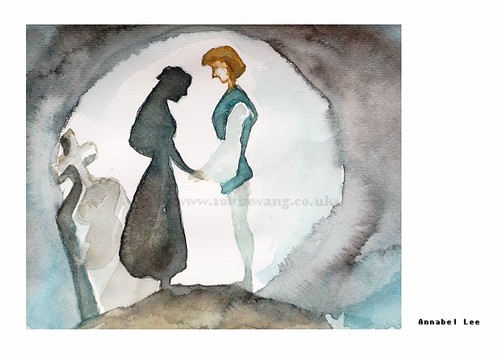
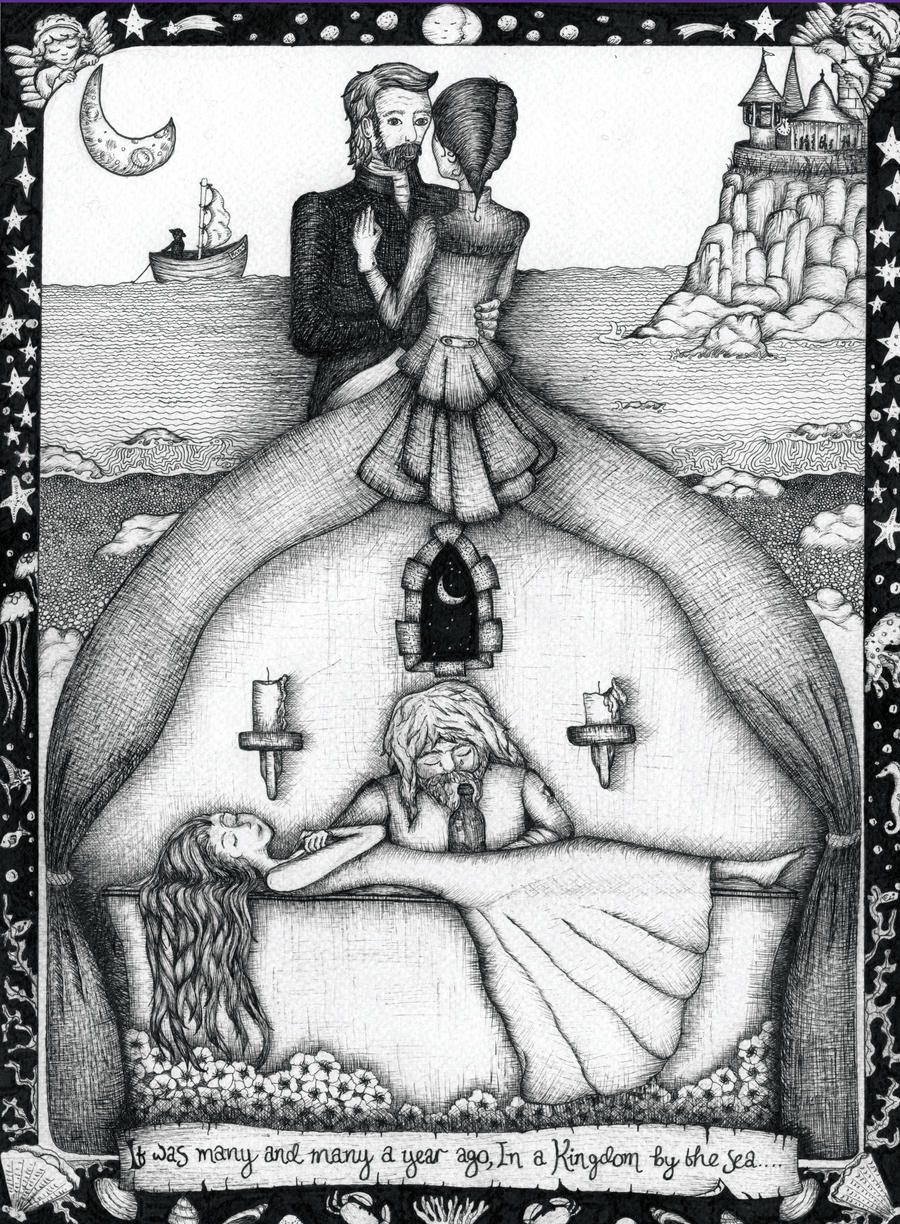
This image ilustrates the poem. Don't miss the envious angels on either side of it! (although they don't seem so mean)


Leonore

   Ah, broken is the golden bowl! the spirit flown forever!
   Let the bell toll!- a saintly soul floats on the Stygian river;
   And, Guy de Vere, hast thou no tear?- weep now or nevermore!
   See! on yon drear and rigid bier low lies thy love, Lenore!
   Come! let the burial rite be read- the funeral song be sung!-
   An anthem for the queenliest dead that ever died so young-
   A dirge for her the doubly dead in that she died so young.

   "Wretches! ye loved her for her wealth and hated her for her pride,
   And when she fell in feeble health, ye blessed her- that she died!
   How shall the ritual, then, be read?- the requiem how be sung
   By you- by yours, the evil eye,- by yours, the slanderous tongue
   That did to death the innocence that died, and died so young?" 

   Peccavimus; but rave not thus! and let a Sabbath song
   Go up to God so solemnly the dead may feel no wrong.
   The sweet Lenore hath "gone before," with Hope, that flew beside,
   Leaving thee wild for the dear child that should have been thy
   bride.
   For her, the fair and debonair, that now so lowly lies,
   The life upon her yellow hair but not within her eyes
   The life still there, upon her hair- the death upon her eyes.

   "Avaunt! avaunt! from fiends below, the indignant ghost is riven-
   From Hell unto a high estate far up within the Heaven-
   From grief and groan, to a golden throne, beside the King of 
   Heaven!
   Let no bell toll, then,- lest her soul, amid its hallowed mirth,
   Should catch the note as it doth float up from the damned Earth!
   And I!- to-night my heart is light!- no dirge will I upraise,
   But waft the angel on her flight with a Paean of old days!"

(Edgar Allan Poe. 1809-1849)


I've chosen Annabel Lee together with Leonore because they are very similar in theme: the death of a young lady and a love that goes beyond that death.Their deaths are seen through the eyes of their living lovers who blame somebody or something else for their young ladys' death. In Annabel Lee the narrator claims that the angels were so jelous of their love that they killed her. In Leonore (in the 2nd Stanza corresponding to de Vere), Guy de Vere claims that mourners shed false tears for Lenore, that in fact they are blamed for her death. 
Poe's use of the name "Lenore" sets a precedent for the melancholy "L" and "O" sounds that dominate the poem's four stanzas. In the case of "Annabel Lee" the use of this final long vowel sound helps the atmosphere of the poem which celebrates and mourns the eternal love of two children.

*The images I've chosen portray the different poems.

Thursday, 8 November 2012

Post 3 : After reading the whole play- Romina Vargas

The most important ideas/themes of the play are:

Love: Stanley begs Stella come back after he had hit her. [The low- tone clarinet moans. The door upstairs opens again. Stella slips down the rickety stairs in her robe. Her eyes are glistening with tears and her hair loose about her throat and shoulders. They stare at each other. Then they came together with low, animal moans. He falls to his knees on the steps and presses his face to her belly, curving a little with maternity. Her eyes go blind with tenderness as she catches his head and raises him level with her. He snatches the screen door open and lifts her off her feet and bears her into the dark flat.] (Page 74)

 Sex and violence: Stanley: [Stanley springs toward Blanche, overturning the table. She cries out and strikes at him with her bottle but his catches her wrist.] Tiger- tiger! Drop the bottle top! Drop it! We´ve had this date with each other from the beginning! [She moans. The bottle top falls. She sinks to her knees. He picks up her inert figure and carries her to the bed.] (Page 176)

Death: Blanche: we dance de Varsouviana! Suddenly in the middle of the dance the boy I had married broke away from me and ran out of the casino. A few moments later—a shot! I ran out – all did! All ran and gathered about the terrible thing at the edge of the lake! I couldn’t get near for the crowding. Then somebody caught my arm. ¨ Don’t go any closer! Come back! You don’t want to see! ¨ See? See what? Then I heard voices say –Allan! Allan! The Grey boy! He’d stuck the revolver into his mouth, and fired—so that the back of his head had been–blown away! (Page 126)

 Desire: I think that desire is another important theme in the play. The major desire from Blanche was to be a bit younger again and get married. She is a sexual woman who wants and needs a man in her life, but when she can’t, she creates them (eg: Shep). All this is the result of having a miserable past.

 I think that the title of the play represents the journey of Blanche towards her new destination which is her sister's home. And Desire has to do with her life and youth that she always is pretending.

While I was reading the play, it made me think about how a person can be affected by loneliness. I think that is very important to our lives to have a family or a friend to get through the difficulties in our lives. In the case of Blanche, she felt so alone and so sorry for her unfortunate past that she got to the point to create her own world in order to hide it, becoming mad.

 If I have the chance to ask the writer a question, I would ask him why Stella decided to sent to her sister to a mental institution instead of trying to help her before or at least try to solve the problem in another way, and not directly enclosing her sister in a mental institution. Because in my opinion, to send her to an institution would be the last option, and I don’t think that Blanche was crazy enough to be enclosed.

Assignment nº2 : Poetry Anthology


(Edna St. Vincent Millay. 1892-1950)

Oh,Oh you will be sorry for that word!
 Give back my book and take my kiss instead.
 Was it my enemy or my friend I heard,
 "what a big book for such a little head!"
 Come, I will show you now my newest hat,
 And you may watch me purse my mouth and prink!
Oh I shall love you still, and all of that.
I never again shall tell you what I think.
 I shall be sweet and crafty, soft and sly;
You will not catch me reading any more:
 I shall be called a wife to pattern by;
And some day when you knock and push the door,
Some sane day, not too bright and not too stormy,
I shall be gone, and you may whistle for me.                         
( Edna St. Vicent Millay)


 I chose this lyrical poem as it was written by a woman and the main theme is precisely the role of women in society. It talks about a man who considers his wife not intelligent enough to read a book, instead of that, she is supposed to be a model wife, sweet and craft and only caring about buying new things.
  The selection of the pictures is pretty obvious as it shows, on the one hand, the expected model wife, beautiful and only using her head to wear hats and, on the other hand, the woman who has her own interests and is not worried about being what she wants to be, although it may involve leaving her husband.


The Parting  (Michael Drayton. 1563 – 1631)      

SINCE there’s no help, come let us kiss and part –
Nay, I have done, you get no more of me;
And I am glad, yea, glad with all my heart,
That thus so cleanly I myself can free.
Shake hands for ever, cancel all our vows,
And when we meet at any time again,
Be it not seen in either of our brows
That we one jot of former love retain.
Now at the last gasp of Love’s latest breath,
When, his pulse failing, Passion speechless lies,
When Faith is kneeling by his bed of death,
And Innocence is closing up his eyes,
- Now if thou wouldst, when all have given him over,
       From death to life thou might’st him yet recover.


 I chose another lyrical poem because I found the major theme of it really interesting. I talks about a marriage that is coming to an end. At first the husband is glad with the separation as it is a clean break and he enjoys his freedom. But then the mood changes and he reveals that the decision is on her hands...if she wants she can go back and recover his love.

In my opinion, these 2 pictures show both feelings: the first one is portraying divorce as a reason for celebration. The second refers to the second mood explained in this poem, the desire of the narrator to recover the love of his wife.


Annabel Lee (Edgar Allan Poe. 1809-1849)

It was many and many a year ago,
In a kingdom by the sea,
That a maiden there lived whom you may know
By the name of ANNABEL LEE;
And this maiden she lived with no other thought
Than to love and be loved by me.

I was a child and she was a child,
In this kingdom by the sea;
But we loved with a love that was more than love-
I and my Annabel Lee;
With a love that the winged seraphs of heaven
Coveted her and me.

And this was the reason that, long ago,
In this kingdom by the sea,
A wind blew out of a cloud, chilling
My beautiful Annabel Lee;
So that her highborn kinsman came
And bore her away from me,
To shut her up in a sepulchre
In this kingdom by the sea.

The angels, not half so happy in heaven,
Went envying her and me-
Yes!- that was the reason (as all men know,
In this kingdom by the sea)
That the wind came out of the cloud by night,
Chilling and killing my Annabel Lee.

But our love it was stronger by far than the love
Of those who were older than we-
Of many far wiser than we-
And neither the angels in heaven above,
Nor the demons down under the sea,
Can ever dissever my soul from the soul
Of the beautiful Annabel Lee.

For the moon never beams without bringing me dreams
Of the beautiful Annabel Lee;
And the stars never rise but I feel the bright eyes
Of the beautiful Annabel Lee;
And so, all the night-tide, I lie down by the side
Of my darling- my darling- my life and my bride,
In the sepulchre there by the sea,
In her tomb by the sounding sea.


The third poem  is a narrative poem I really enjoyed reading. It is a love poem that tells us the story of two children who deeply love each other...so deeply that the angels of heaven are so envious of that love that decide to kill the little Annabel Lee. Nevertheless, no one can separate them, and that love transcends death and lives forever.
The picture clearly illustrate the love of two infants and this idea is reinforced by the text appearing on it: "Love is a moment that lasts forever".

Tuesday, 6 November 2012

Poetry Anthology

Poetry Anthology:Lyrical and Narrative poems.

  The Hind

Whoso list to hunt, I know where is an hind,
 But as for me, helas! I may no more.
 The vain travail hath wearied me so sore,
 I am of them that furthest come behind.
 Yet may I, by no means, my wearied mind
 Draw from the deer;but as the fleeth afore
 Fainting I follow I leave off therefore ,
 Since in a net I seek to hold the wind.
Who list her hunt, I put him out of doubt,
As well as I, may spend his time in vain;
And graven with diamonds in letter plain
There is written, her fair neck round about,
 Noli me tangere, for Caesar's I am,
 And wild for to hold, though I seem tame.
 (Sir Thomas Wyatt)


 Oh,Oh you will be sorry for that word!

 Give back my book and take my kiss instead.
 Was is my enemy or my friend I heard,
 "what a big book for such a little head!"
 Come, I will show you now my newest hat,
 And you may watch me purse my mouth and prink!
Oh I shall love you still, and all of that.
I never again shall tell you what I think.
 I shall be sweet and crafty, soft and sly;
You will not catch me reading any more:
 I shall be called a wife to pattern by;
And some day when you knock and push the door,
Some sane day, not too bright and not too stormy,
I shall be gone, and you may whistle for me.
( Edna St. Vicent Millay)


The Wife of Bath's Tale (extract)
Now it so happened, I began to say,
Long, long ago in good King Arthur's day,
There was a knight who was a lusty liver.
One day as he came riding from the river
He saw a maiden walking all forlorn
Ahead of him, alone as she was born.
And of that maiden, spite of all she said,
By very force he took her maidenhead.
This act of violence made such a stir,
So much petitioning to the king for her,
That he condemned the knight to lose his head
By course of law. He was as good as dead
(It seems that then the satutes took that view)
But that the queen, and other ladies too,
Implored the king to exercise his grace
So ceasellessly, he gave the queen the case
And granted her his life, and she could choose
Whether to show mercy or refuse.


I've chosen these poems because I think that they show different women being powerful so as to be and do whatever they want with men and with their lives.
The first woman is very coquette and encourages men to follow her because she enjoys her power over men and enjoys the way men try to get her love. She can do with them whatever she wants. That's why I've chosen that picture as it clearly shows a coquette women being followed by men.
The second woman enjoys reading and she will keep on doing it eventhough her husband doesn't want her to read. She is strong enough to confront with her husband and make him clear that she will pretend to be what he asks her to be but she will not stop reading. I've chosen these pictures because they show a woman with her husband (may be in a party) showing that they are a very happy couple, and then the other picture a woman alone reading and enjoying this activity.
The third woman is a queen and it is shown that  she has power on the king as he let her choose what to do with the knight. I like this  picture as it can represent the ladies and the queen dealing with the Knigth's case.


Monday, 5 November 2012

Much Ado About Nothing

Post 1 - Before Reading

What is the most relevant information provided, in your view? What is the most surprising? 

 In my view, the most relevant information provided is that the original Globe Theatre was in the seedy section of town, frequented by prostitutes, pickpockets and indecent people. Also, there was no curtain that opened or closed at the beginning or end of plays. It was also mentioned that there wasn´t much decoration or scenery. What surprised me is how people entretained themselves going to the Bear Gardens, and seeing bears being attacked by dogs. That was an awful practice of that time.

How do you think the acting conditions will affect the development of the plot?

I suppose that acting those days must have been a difficult activity limited to those who really loved doing it. First, as I  saw in the film "Shakespeare in love", people used to round the stage until the edge of it. That was a lot of pressure put on actors, as people who got bored boo and hiss them. And, above all, men interpreted all characters, even female characters, and they should be believable.

How do these two versions compare? Why? Who do you expect the protagonists will be? What do they seem to be like?

I think the characters in the first version are meant to be more real than in the second one, as most of them are not attractive as they might have been in reality. In the second version, almost all of them are good-looking which makes the film more attractive to the public. Apart from that, the setting in the first didn´t change, at least in the part that is shown, and in the second one, the setting seems to be more vivid.
In my view, the protagonists seems to be Hero and Claudio in the TV play, while in the film Leonato´s niece and Benedick are more likely to be the leading roles. Hero and Claudio are very shy and quiet. Claudio are determined to get the love of Hero. On the other hand, Benedick and Leonato´s niece seem to be forthright and they seem not to like each other.

Post 3 - After Reading The Whole Play

What are the most important ideas/ themes in this play? Is there any phrase or line you think represents them best? How suitable is the title?

The major theme is marriage as all the problems in the play result of it. It is represented in the following lines:

Benedick:    "... But I hope you have no intent to turn husband, have you?
Claudio:       I would scarce trust myself, though I had sworn the contrary, if Hero would be my wife"

Beneddick:   "No, the world must be peopled. When I said I would die a bachelor, I did not think I
                    should live till I were married."

Margaret:     "Of what, lady? Of speaking honourably? Is not marriage honourable in a beggar? Is not your 
                     lord honourable without marriage? I think you would have me say 'saving your reverence, a
                     husband.'; an bad thinking do not wrest true speaking, I'll offend nobody. Is there any harm in
                     'the heavier for a husband'? None, I think, an it be the right husband and the right wife; 
                     otherwise 'tis light, and not heavy. Ask my Lady Beatrice else - here she comes."

Another important theme is deception. It is shown throughout all the play: when they tried to get what they want; when they tried to make Benedick and Beatrice fall in love; when Don John made Claudio believe Hero was disloyal too him or when Hero pretended to be dead.

Don John:     " I came hither to tell you, and, circumstances shortened - for she has been too long a-talking
                    of - the lady is disloyal.
Claudio:        Who, Hero?
Don John:     Even she. Leonato’s Hero; your Hero; every man’s Hero.
Claudio:        Disloyal?
Don John:     The word is too good to paint out her wickedness. I could say she were worse - think you of
                     a worse title, and I will fit her to it. Wonder not till further warrant. Go but with me tonight,
                     you shall see her chamber window entered, even the night before her wedding day. If 
                     you love her then, tomorrow wed her; but it would better fit your honor to change your mind.
Claudio:         May this be so?
Don Pedro:    I will not think it."

The title is very suitable because in the play there are a lot of trouble (ado) but in the end nothing happened.
They made a lot of things out of nothing ( eg.: When Don John set a conflic between Hero and Claudio that in fact doesn't exist)
What surprised me more was the way in which Beatrice, being a woman, can show what she thought, and the way she can express to men which was unusual in those days.
If I got the chance, I would ask the writer why the character of Hero didn't even tried to fight for her innocence. 


Assignment nº2 : Poetry Anthology


Poetry Anthology


Sunday, 4 November 2012

Post 3: "Much Ado About Nothing" - Nerina Franguelli

After talking about it in class, I think that the important themes in the play are: marriage and property, love, virginity and the idea of Appearances vs. Reality that can be perceived throughout the play.
Marriage:
At that time, marriage brought two families and their property together and with this combined wealth came greater influence over public events. The grander the family, the more direct influence parents expected to have over their children’s choice of marriage partner. In this play we can see that when Hero is thought to have “shamed” the family Leonato treats her with brutality and wish her dead.
Furthermore, different views over marriage are presented, e.g:
- Benedick didn’t believe in long happy marriages, or in women being faithful and he define it as a kind of prison:
“In faith, hath not the world one man but he will wear his cap with suspicion?”
“An thou wilt needs thrust thy neck into a yoke, wear the print of it – and sigh away Sundays.”

- As regards Beatrice, everyone wanted her to get married. They thought that it would calm her down because her behaviour was not suitable for a lady. But like Benedick, she didn’t want to marry, perhaps because she thought it would be difficult to her since she is an orphan.
Leonato: “By my troth, niece, thou will never get thee a husband if thou be so shrewd of thy tongue.”

Love:
A distinction can be made between the different couples: I think that the most believable couple is that of Beatrice and Benedick since both characters are more developed than those of Hero and Claudio and because we see them express their opinion in different situations. Love doesn’t seem to exist between Hero and Claudio since they seem to accept facts or other peoples’ ideas without complaining and they change their mind easily. Besides, we can see Claudio interested in the matter that Hero is an only-child.
Claudio: “Hath Leonato any son, my lord?”

Virginity: at that time, “an unchaste woman lost her value on the marriage market; and if already married, she might corrupt the pure line of descent by insinuating a bastard into it. Consequently a young virgin was counselled to live before her marriage in an utterly chaste manner.”
Margaret Loftus Ranald, Shakespeare and His Social Context, 1986.

Appearances vs. Reality: this idea is well developed in this play since the contrast can be noticed in a number of situations, e.g: in the use of masks at the ball, when Hero is thought to be dead, etc.

As explained in class and in the post of Alejadra Simoncelli the title has two interpretation: the literal one, that implies that a great fuss ("much ado") is made of something which is insignificant ("nothing"), pointing as an example the situation of the wedding when Hero is thought to be unfaithful; and other interpretation that arises if we consider the play on the words “nothing” and “noting”, which, in Shakespeare’s day, were pronounced as homophones. Besides, I´ve found that “nothing” was Elizabethan slang for "vagina", evidently derived from the pun of a woman having "nothing" between her legs.

What surprised me about this play is the way it is written and the use of different devices that aimed at different social classes: “malapropisms” entertained groundlings, whereas “puns” entertained the nobility.

The play made me think about how easily we are sometimes persuaded in certain situations by other peoples´ words and made me remember that we have to think twice before believing what other people say or before basing our acts in relation to things that we´ve been told of.

If I had the chance to ask William Shakespeare a question I would ask him why is the character of Hero not much developed. I would like to know more about her and her thoughts.

Saturday, 3 November 2012

Anthology- María Celeste Muttis

Please click here:

http://prezi.com/mdth08hpgfq8/anthology-maria-celeste-muttis/

Poetry Anthology - Nerina Franguelli


Poetry anthology: Poem 3


Poem N° 3: 


Hope is the thing with feathers
That perches in the soul,
And sings the tune without the words,
And never stops at all,

And sweetest in the gale is heard;
And sore must be the storm
That could abash the little bird
That kept so many warm.

I've heard it in the chillest land,
And on the strangest sea;
Yet, never, in extremity,
It asked a crumb of me.

Emily Dickinson 1830-1886

Please click here, It´s beautiful...http://vimeo.com/33318564
I really liked this lyrical poem because one of the messages of it seems to say that whatever life throws at the individual there is always the dove-like glimmer of hope that sits in all of us that is so strong that its voice can still be heard in the "gale" of stormy times. Everyone goes through stormy times in their life and no matter where you are on earth or from which "strangest sea" you inhabit but there is no need to despair.
I have chosen these images because of  Dickinson´s metaphor, "is a bird that perches in the soul of everyone", regardless of race, gender or status. It is clear that whatever the battles we may face, hope wins through in the end.